
Performing Umrah is a sacred journey that requires both spiritual focus and clear practical knowledge. This comprehensive, step-by-step guide is designed specifically for Pakistani pilgrims, walking you through every ritual—from putting on Ihram before your flight and crossing the Miqat to performing Tawaf, Sa’i, and booking your Rawdah permits on the Nusuk app.

Preparation in Pakistan & Entering Ihram
Preparing for your spiritual journey begins long before your plane departs from Pakistan. Achieving full readiness requires executing specific physical purification steps at home alongside proper intention before reaching the sacred boundaries.
- Physical Purification: Complete your personal hygiene by performing Ghusl (a full ritual bath), trimming your nails, and clipping unwanted body hair. Applying non-alcoholic attar (fragrance) directly onto your skin is Sunnah at this preparation phase, but avoid getting any perfume on your actual Ihram sheets.
- Ihram Attire Rules: Male pilgrims wear two unstitched, white cotton sheets—the Izar (secured around the waist) and the Rida (draped over the upper body). Female pilgrims can wear any simple, modest Islamic attire that fully covers the body, keeping only the face and hands exposed.
- Managing the Miqat on Pakistani Flights: If you are flying direct to Jeddah (via PIA, Airblue, SereneAir, or Saudia), you must enter the state of Ihram before passing the aerial Miqat point (Yalamlam or Qarn al-Manazil). It is most practical to change into your Ihram sheets at your departure airport—such as Islamabad (ISB), Lahore (LHE), Karachi (KHI), or Multan (MUX)—so you are fully prepared when the flight crew announces the boundary approach.
- Formulating Niyyah & Talbiyah: Just before your flight crosses the Miqat line, state your explicit intention (Niyyah) for Umrah in your heart or verbally, then begin reciting the Talbiyah: “Labbayk Allahumma Labbayk, Labbayka Laa Shareeka Laka Labbayk…”
Rules & Restrictions of Ihram
Entering the state of Ihram places a pilgrim under specific sacred prohibitions designed to foster complete humility and focus on Allah. From the moment you state your Niyyah at the Miqat, you must strictly observe these restrictions until your Umrah rituals are fully completed.
- Prohibition on Perfumes & Scented Products: You cannot apply attar, body sprays, or scented lotions once in Ihram. Additionally, ensure you use unfragranced, scent-free soaps during washing or bathing while in Makkah.
- Hair & Nail Alterations: Trimming, cutting, or plucking any hair from your head, face, or body is strictly prohibited. Similarly, clipping or filing your finger or toenails is forbidden until the final ritual step (Halq or Taqsir).
- Head & Face Coverings (Gender-Specific): Male pilgrims must keep their heads and ears completely uncovered—wearing caps, hoods, or traditional towels over the head is not allowed. Female pilgrims must leave their face exposed without wearing a fitted face-veil (Niqab), though a loose headscarf (Hijab) covering the hair remains mandatory.
- Footwear Restrictions: Men cannot wear enclosed shoes, socks, or footwear that covers the top ridge of the foot or ankles. Sandals or flip-flops with open tops and exposed heels must be worn. Women may wear regular shoes and socks.
- Interpersonal & Behavioral Conduct: Heated arguments, harsh language, offensive behavior, and any form of marital or sexual relations are explicitly forbidden during Ihram.
- Penalties for Violations (Damm or Sadaqah): Accidental or necessary violations—such as using scented soap or pulling out hair due to intense scratching—require paying an expiation penalty in Saudi Arabia, which ranges from feeding local poor individuals (Sadaqah) to sacrificing a small livestock animal (Damm).

Performing Tawaf al-Umrah (Circling the Holy Kaaba)
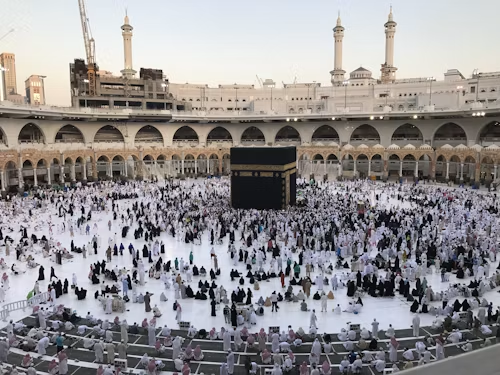
Upon entering Masjid al-Haram, step inside with your right foot and recite the entry supplication (Bismillah, was-salatu was-salamu ‘ala Rasulillah, Allahumma aftah li abwaba rahmatik). Tawaf consists of circling the Holy Kaaba seven times in a counter-clockwise direction, demonstrating unity and devotion.
- Executing Idtiba (Men Only): Before starting Tawaf, male pilgrims must uncover their right shoulder by passing the top sheet of the Ihram (Rida) under the right armpit and draping it over the left shoulder.
- Starting Point & Istilam: Move to the line aligned with the Black Stone (Hajar al-Aswad), marked today by a clear green light on the mosque wall. Raise your hands toward the Black Stone, face it, and say “Bismillahi Allahu Akbar”, gesturing toward it (Istilam).
- Performing the Circuits: Begin walking counter-clockwise with the Kaaba on your left side. For men, performing Raml (a brisk, short-paced walk with shoulders moving) during the first three circuits is Sunnah, followed by a normal walking pace for the remaining four.
- Between Rukn al-Yamani & Hajar al-Aswad: When walking between the Yemeni Corner (Rukn al-Yamani) and the Black Stone, it is highly recommended to recite:“Rabbana atina fid-dunya hasanatan wa fil-akhirati hasanatan wa qina ‘adhaban-nar”
- Post-Tawaf Prayers & Zamzam: After completing all seven laps, cover your right shoulder back up. Pray two Rak’ahs behind Maqam Ibrahim (or anywhere in the Haram if crowded), then drink holy Zamzam water and make supplications before heading to Sa’i.
Performing Sa’i (Walking Between Safa & Marwah)
Sa’i commemorates the journey of Hazrat Hajar (R.A.) as she searched for water for her infant son, Hazrat Ismail (A.S.). It consists of walking back and forth seven times between the two hills of Safa and Marwah inside the Al-Masjid Al-Haram complex.
- Beginning at Mount Safa: Walk toward Mount Safa. As you approach the hill, recite the Quranic verse: “Innas-Safa wal-Marwata min sha’a’irillah” (Surah Al-Baqarah 2:158). Ascend the hill, face the Kaaba, raise your hands in supplication, and make personal duas.
- Walking the Laps: Descend Safa and head toward Marwah. Walking from Safa to Marwah counts as Lap 1. Returning from Marwah to Safa counts as Lap 2, continuing until you finish your 7th lap at Mount Marwah.
- The Green Light Zone (Men Only): Between the two hills, you will pass a section marked by bright green overhead lights. Male pilgrims are expected to run lightly or jog briskly through this section, while female pilgrims continue at a regular walking pace.
- Ending at Marwah: Upon completing the seventh lap at Mount Marwah, face the Kaaba direction, make your final supplications, and prepare for the concluding step of your Umrah.

Exiting Ihram: Halq or Taqsir (Hair Trimming/Shaving)
To conclude your Umrah rituals and officially exit the state of Ihram, hair trimming or shaving must be performed. Once this step is completed, all regular Ihram restrictions are lifted, and you may change back into everyday clothes.
- Male Pilgrims (Halq vs. Taqsir): Men have two choices:
- Halq (Complete Head Shaving): Highly recommended in Islamic tradition for men due to its immense spiritual reward.
- Taqsir (Even Trimming): Trimming hair equally from all sides of the head. Simply cutting a small lock of hair from one side is insufficient; hair must be shortened evenly across the entire head.
- Female Pilgrims (Taqsir Only): Women do not shave their heads. A woman should gather her hair and cut roughly a fingertip’s length (approximately one inch) from the ends of all her hair.
- Self-Trimming Rules: Once you arrive at the barbershop or your hotel room, you may cut your own hair or trim someone else’s hair to exit Ihram, provided the rituals of Tawaf and Sa’i are fully finished.
Visiting Madinah & Booking Rawdah Permits via Nusuk App
After completing your Umrah in Makkah, traveling to Madinah Al-Munawwarah to visit Al-Masjid an-Nabawi provides a peaceful spiritual balance to your journey. While entering the Prophet’s Mosque for daily prayers requires no permit, visiting the Noble Rawdah (Riyadh ul-Jannah) and offering Salam at the Sacred Chamber strictly requires an official digital permit under Saudi regulations.
- Understanding the Nusuk Requirement: To enter the Rawdah (the area between the Prophet’s pulpit and his noble chamber, marked by green carpets), every pilgrim must hold an active permit generated through the Nusuk app. Physical paper passes or verbal requests are not accepted at the entry gates.
- Step-by-Step Rawdah Booking Process:
- Account Registration: Download the Nusuk app on your smartphone. Register using your Passport Number, Visa Number (found on your issued Saudi Umrah visa), date of birth, and nationality.
- Select Permit Category: Navigate to Prophet’s Mosque Services and select Praying in the Noble Rawdah. Note that male and female bookings are separate, as visiting hours and designated gates differ.
- Choose Time Slot: The calendar will show available days in Green (available) or Red/Grey (fully booked). Select an open date and choose your preferred 30-minute time window.
- Issue & Save Permit: Confirm your selection to generate an active QR code permit. Take a screenshot of the QR code immediately to ensure access even if mobile data signal is weak near the mosque gates.
- Crucial Tips for Securing Slots:
- Book Early: Slots are released in batches (often 7 to 10 days in advance or weekly on Fridays) and fill up within minutes. Check the app frequently as soon as your Umrah visa is approved.
- Off-Peak Refreshing: If slots appear full, check the app during late-night or early-morning hours in Saudi Arabia (KSA time) when cancellations are periodically re-released into the system.
- Etiquette During Your Visit: Arrive at your assigned gate at least 20 to 30 minutes before your scheduled slot. Maintain a calm demeanor, lower your voice, offer two Rak’ahs of voluntary prayer (Nafl) if space allows, and recite blessings (Salawat) upon Prophet Muhammad ﷺ during your allotted time inside.
Written by: Gharnata Future Consultant
Last Updated: August 2026